

…in conversation with Artist Ryan Mutter
By Anne Marie Hillan
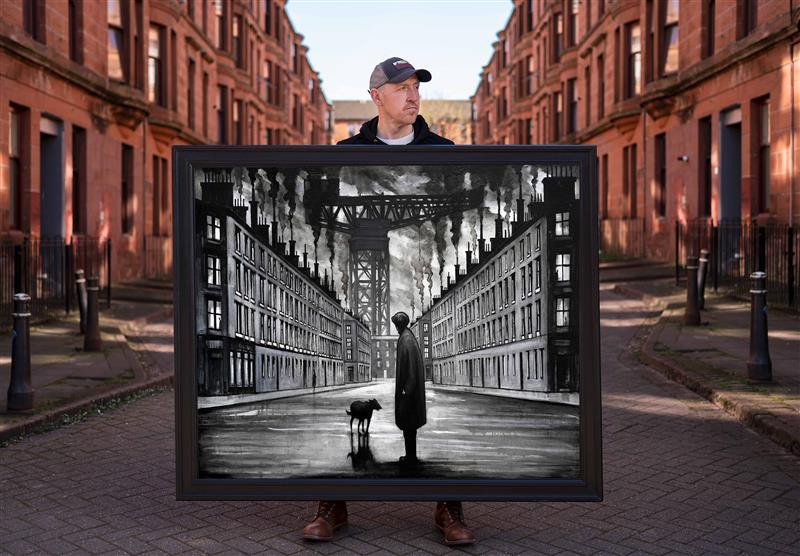
Glasgow’s West End is full of artists, which is hardly surprising given its proximity to the world-famous Glasgow School of Art. But what are their stories? What inspires them to paint? Anne Marie Hillan met Artist Ryan Mutter, a Scottish artist who finds inspiration in the industrial landscape of the Clydeside shipyards and the labour of the men who worked there.
FIRST IMPRESSIONS
I first came across Ryan Mutter’s work in a West End gallery. The painting drew me in instantly – the dark tones, the scale, and the faces of proud working men. Later, I spotted another of his pieces on the walls of Ashton Lane, and again in a neighbour’s home. Each time, his work stopped me in my tracks.
Ryan’s paintings are dark, vivid, and alive with the history of the Clydeside shipyards. Working with Westender allows me to meet people whose work fascinates me, and I was eager to hear the story of the man behind these unforgettable images. We met in the heart of the West End, where he told me how his art grew from his family, his heritage, and his own experience.
ROOTS IN CLYDEBANK
Ryan’s father’s family were from Clydebank. His father was born and raised in Faifley, and when Ryan was a boy, visits to his dad’s relatives often included detours into Glasgow and Clydebank. As they drove, his father narrated the city’s social history – the shipyards, the communities,
the thousands of men who laboured there.
Ryan remembers being shown the single-end flat where his father was born and seeing Clydebank in the late ’70s and ’80s, when shipyards and housing were being flattened and rebuilt. The young Ryan loved these trips – natural, personal lessons in social history.
Both of Ryan’s parents were artistic. His father studied at Glasgow School of Art and later became an art teacher. His mother also had a creative streak. Ryan grew up surrounded by art – in and out of the School of Art building, attending degree shows and exhibitions with his dad. He has strong, emotional almost magical memories of watching art students with their portfolios and knew from an early age that he wanted to be an artist.
He tells me he did well academically, better than folk expected, so his parents encouraged him towards what they thought was a steadier path. He started at Glasgow School of Art to study architecture, but his heart wasn’t in it. Sitting through architecture classes while yet again watching art students with their portfolios convinced him to change course. By the end of his first year he switched to painting.
Oil became his medium. He had watched his dad paint with oils and remembers when his father first let him try.
After graduating, he taught at Kilmarnock College and later Springburn College, always painting on the side. Another formative chapter came when he worked as an industrial plumber. The work was tough and physical, but Ryan remembers the camaraderie – the banter, the solidarity, the friendships forged through graft. That experience left him with an empathy for working men that would later shape his art.
FINDING THE SHIPYARDS
At first, Ryan painted buildings and boxers. When someone suggested he paint shipyards, it proved a turning point – once he started, there was no going back. He painted on large canvases, which initially sat at the end of his bed. By 2009 he was a full-time professional artist.
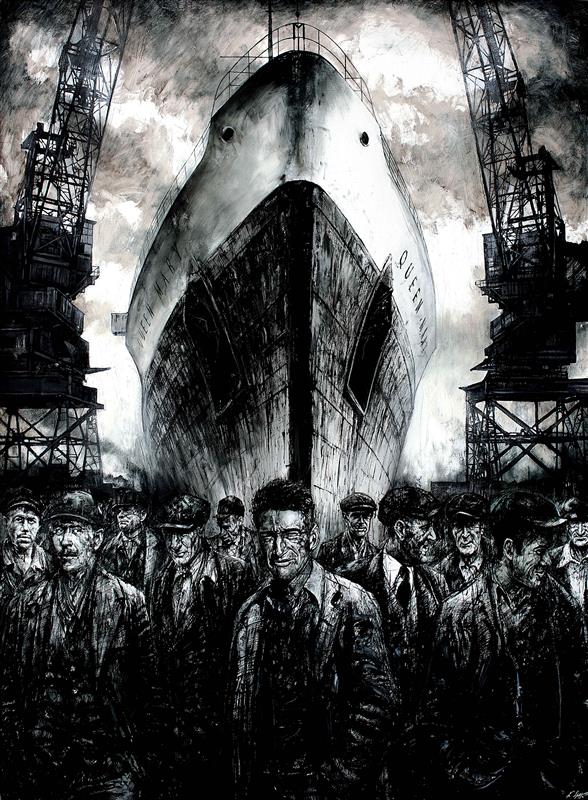
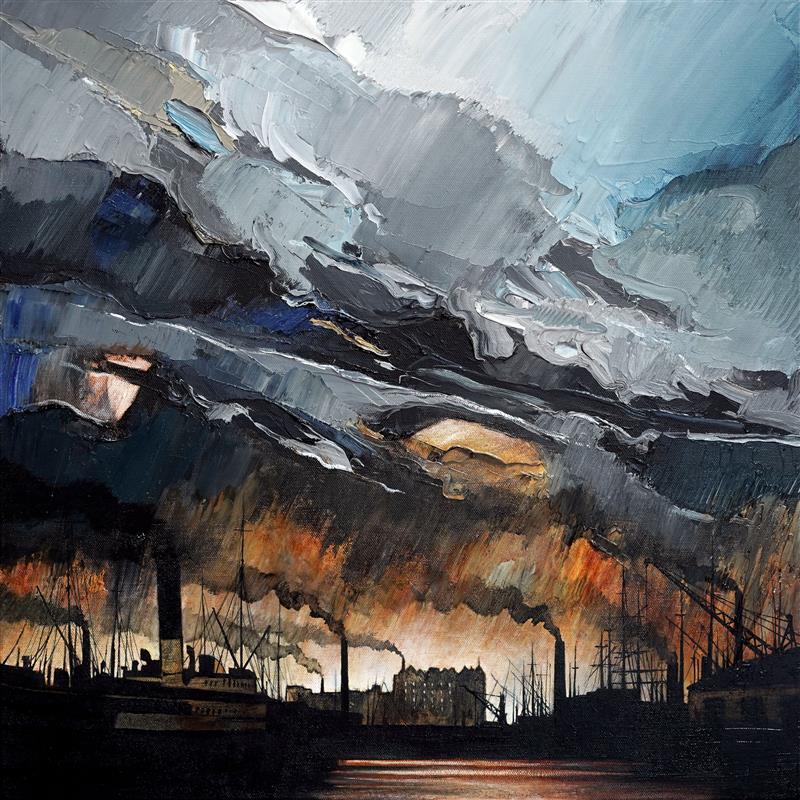
His shipyard and Glasgow paintings are monumental. They can take many weeks or even months to complete – the larger ones up to three months, most around six weeks. As the oils dry slowly, he often works on up to ten pieces at once. Ryan researches each painting meticulously, studying archive film, photographs and records, building the image detail by detail. The results are powerful, almost cinematic. His paintings tell the story of Clydeside industrial life – of the shipyards, the men, and the city built around them.
He’s produced hundreds of works now. When asked for a favourite, he chose The Pride of the Clyde – one of several paintings commemorating the building and launch of the Queen Mary in September 1934. Built at John Brown & Co. in Clydebank, the Queen Mary was then the largest ocean-going vessel in the world, significantly bigger than the ill-fated Titanic.
The canvas shows the bow of the Queen Mary flanked by cranes rising into a dark sky. Beneath it stands a tide of weary but proud shipyard workers. There’s no romantic gloss – just hard, honest imagery. Yet on closer look, some of the men have a twinkle in their eye, a spark of humour that captures not only their pride but the camaraderie that defined life in the yards.
Recognition has followed. Billy Connolly, who famously worked in the shipyards, once phoned Ryan and left him a voicemail praising his work. Ryan still really wishes he had answered that call! Later, Billy was gifted one of his paintings, The Govan Boys. A proud moment for Ryan. Another work even made its way to the Pope.
For many, their first encounter with Ryan’s work comes outdoors rather than in a gallery. His mural on Ashton Lane has become a West End landmark. Commissioned by the late Bruce Finnie, who ran the By Distinction Gallery on Byres Road, it brings shipbuilding imagery into one of Glasgow’s liveliest streets. Folk take photos beside it and send them to Ryan – something he still finds both surreal and heartening.
BEYOND THE CANVAS
Ryan is clear that his paintings are not intended to be political statements. They are celebrations of Clydeside heritage, hard work and human spirit, honouring the men who built ships that sailed the world. But he is also aware of the cost: many of those men were exposed to asbestos. Ryan has supported Clydebank Asbestos Action and Glasgow’s Maggie’s Centre, donating paintings for auction to raise funds for charities that support the Clydeside workers and their families.
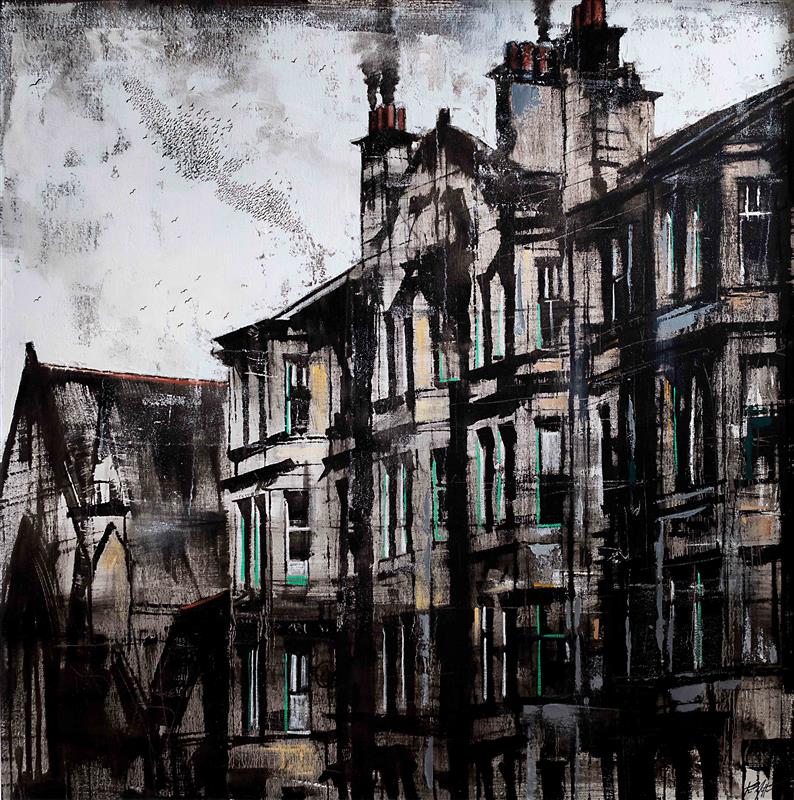
His work also remembers how these men lived literally in the shadows of the yards – the noise and the great hulks of ships a constant presence in their lives. Ryan’s work The Streets Where I Belong is a particular favourite of mine.
Alongside his industrial paintings, Ryan also paints landscapes and buildings. In contrast to the dense detail of the shipyard scenes, these works are looser and more lyrical – a way of exploring space and light differently but still with his signature intensity.
A PERSONAL CONNECTION
Ryan Mutter paints with power, detail and heart, and I really enjoyed talking with him. His interest in the shipyards and the camaraderie of the working men is as genuine as the paintings he produces.
For me, it carries something even more personal. My father, like Ryan’s, was brought up in Clydebank. My dad often told me about being a boy at the launch of the Queen Mary in 1934, lifted high on my grandfather’s shoulders above the crowd. He remembered the noise, the pride, the sheer spectacle of the day. It’s a story I grew up with – part of my own family’s history.
To see Ryan’s painting is to see that memory brought vividly to life – a moment my father was part of, commemorated in oil and canvas. A real moment of pride passed down through generations. That is what makes Ryan’s work so compelling: it doesn’t just depict history it brings it to life, carrying the past into the present and into our homes, reminding us to celebrate and remember those generations of working men who built ships that were, at the time, the best in the world. What a gift.
EXHIBITIONS
Every April, Ryan exhibits new work at the Lemond Gallery in Bearsden. He also sells work from his own website. He has always had close ties to the West End and his paintings are also available at Arteries Gallery in Kelvinbridge, Finnieston Clothing on Byres Road, and Rag & Bone in the Hidden Lane, Finnieston.
For prints and more information on Artist Ryan Mutter, visit –