
Europe’s Tree of the Year?
by David Treanor, Arborist
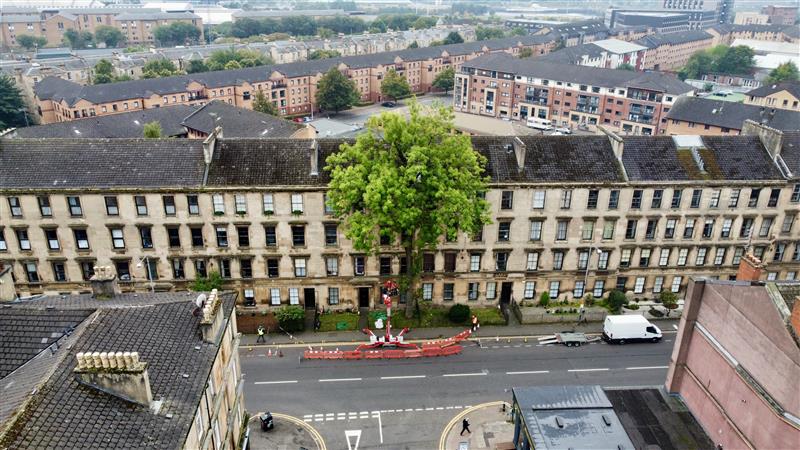
‘At the west end of Argyle Street there is a four-storied tenement known as Franklin Terrace, which has a narrow strip of garden ground in front of it. About the middle of this tenement, at number 1223, there stands a very tall ash tree, it’s highest branches reaching far above the top windows of the tenement.’
These words, the earliest known account, were written almost a century ago in 1935 by James Cowan and included in his book, From Glasgow’s Treasure Chest which secured the folklore of a tree that was officially announced on the BBC One Show in September as the Woodland Trust’s UK Tree of the Year for 2025.
Although the award is national, the honour truly belongs to the people of Kelvinhaugh. This tree is theirs: a neighbour, their ‘big tree’, and now a symbol of hope for all urban trees.
The ‘Only Tree on Argyle Street’, as it is known, has quietly become part of Glasgow’s emotional architecture, archiving the city’s history in its rings.
It may not have been planted with any fanfare, yet its story intertwines the history, resilience, and community spirit of the West End.
An Origin Story Rooted in the Ordinary
The book recorded a charming origin story: a West End family returned from holiday ‘doon the watter’ around 1855 with a clump of primroses, planted them as a memento at Franklin Terrace and were surprised when a tiny ash seedling emerged among the flowers. They let it grow, perhaps never imagining it would, 170 years later, tower 25 metres tall.
For decades it stood largely unnoticed –part of the urban fabric, shaping itself quietly through the hostile pea soup era, eventually enduring the Clydeside blitz, numerous storms and changing city life.
It has stood as a natural waymarker, orienting anyone exiting to the south of Kelvingrove Park towards Gray Street for many years before Google maps existed where this gallus monument is now to be found as a local landmark.
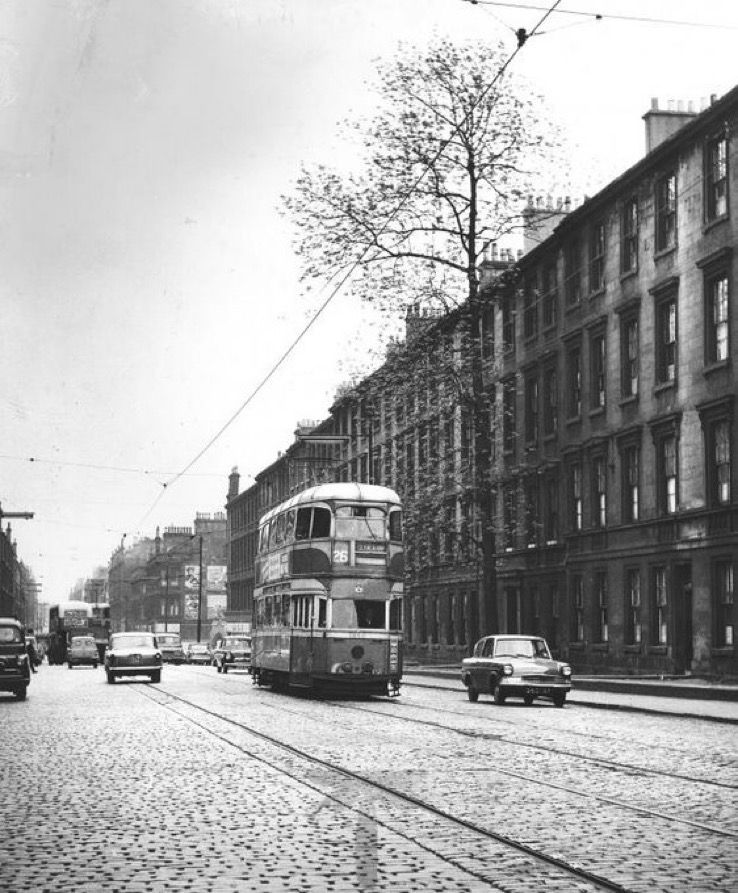
Our tree is older than the telephone, older than the light bulb and has seen everything from horse-drawn trams to Teslas. The aerial electric tram cables installed in front of the tree in 1897 provided protection until their removal in 1962, making it impossible to fell the tree decades before skilled arborists existed.
Twenty years later, Glasgow City Council made the progressive decision to legally protect it with the very first tree preservation order, officially making it the city’s No.1 tree.
Refusing to Follow the Script
When ash dieback spread to Scotland thousands of trees began to decline rapidly.
The defiant giant, however, did not follow the script. Against the expected inevitability, it resisted. Its crown thinned only slightly. Through conservation pruning and optimistic monitoring, it’s vigour held.
Research into this resilience illuminated how the unique urban environment at 1223 Argyle Street, despite the apparent hostility of the hard landscape, helped the tree survive.
It seems the effect of the fungus is only terminal if the fallen leaves gather at the base and release their spores nearby the following year. Our tree, in isolation, disperses it’s leaves from a great height, where they’re carried on the wind down this busy thoroughfare and collected in the wake of vehicles below.
A Counter Narrative to Loss
The tragic and mindless destruction of the gap tree at Hadrian’s Wall and the devastating effect of storm Eowyn on the vulnerable and ancient tree in Darnley stirred the emotions for two sycamores when it was too late. Sudden loss like that leads to feelings of regret for those who meant to but didn’t pay their respects.
It was in this context that, as the advocate who cares for the tree, I emailed my nomination in June and our tree was shortlisted as the only public entry and the only urban specimen, nine significant others being chosen by the panel of experts.
The avoidable decline of those trees provided the key to opening up the treasure chest to this one, and we inherited a living counter narrative to loss.
It became my mission to tell its story in order to encourage understanding, appreciation and protection because we absolutely must value these living witnesses before we lose them.
The Rewards of Conservation
Social media holds a record of people’s love for this tree and lists the ways in which it has planted its seed in the hearts of so many generations. Posts about it evoked involuntary memories from childhood:
‘My mum and dad met under this tree’, ‘my granny taught us about this tree’.
Stories of kittens stranded up it and toys thrown into it from tenement windows were shared reminding us that trees like this one keep the time; standing as a constant, anchoring presence in a river of change.
Others would share wrong assumptions in the comments with conviction, about how the tree should be felled, believing the roots must be damaging the building.
Urban trees rarely live long enough to reveal their deeper wisdom. Too often they are cut down preemptively for fear of what might happen – fears that are frequently unfounded. The Argyle Street Ash stands as a myth busting mirror showing what becomes possible when a tree is simply allowed to be and what they can become.
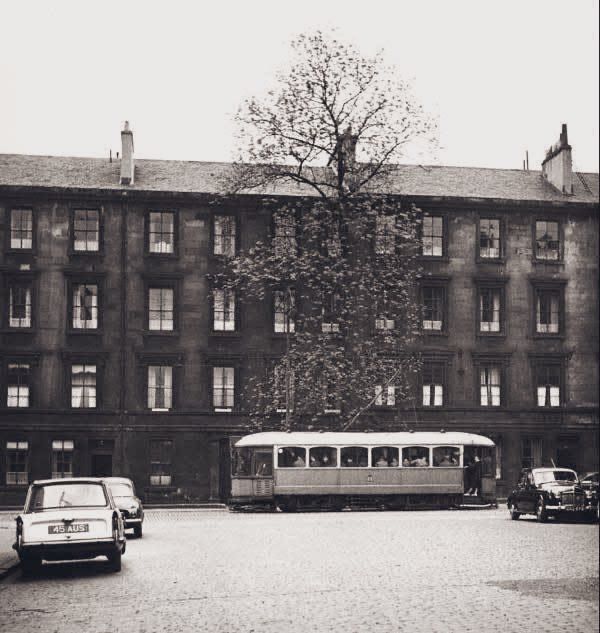
The Rewards of Conservation
A tree that reunited a family…
As the story of the tree resurfaced, something remarkable happened. The Lilly family whose ancestors migrated to Glasgow from Ireland, living at number 1223 in the 1930s, saw the campaign online. They returned to visit it, reached out, connected across continents, and shared photographs and memories of the tree.
They met in the Park Bar, a long established hub for the wave of fellow factory and dock workers settling during the industrial revolution from the Highlands and Islands. The campaign, in essence, reunited a family, brought here by history then scattered across time and geography.
It became clear: this tree is deeply woven into people’s lives and can act as a portal to the past.
Painted, Photographed, Celebrated
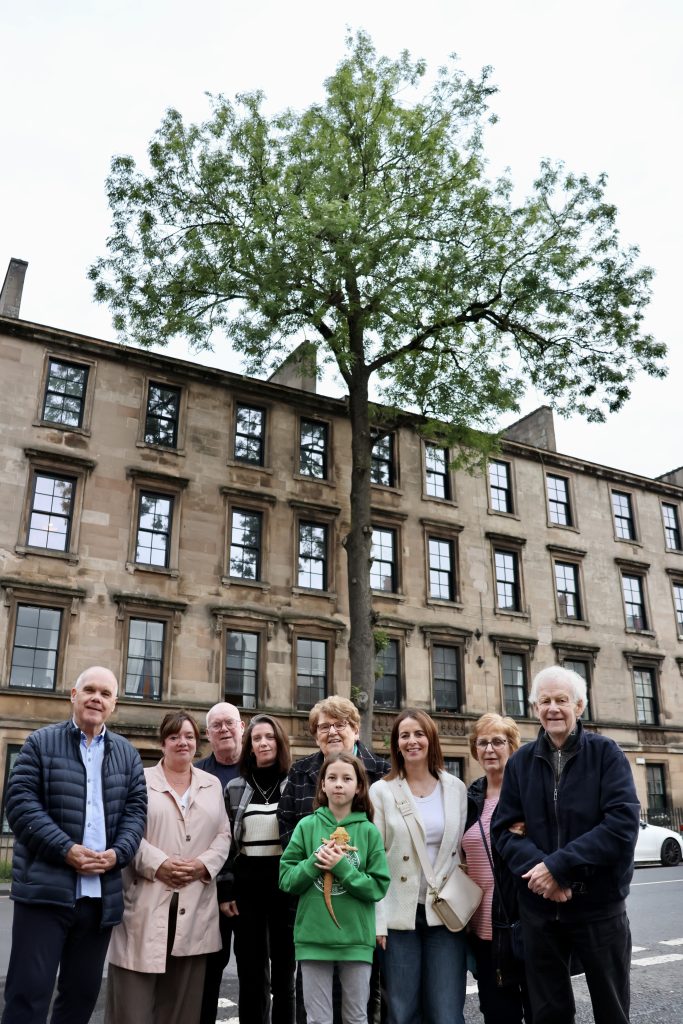
Once the ash was brought into public focus, there was a tide of creativity normally reserved for public monuments. A Facebook reel by a local MSP was viewed 250,000 times. Comedy sketches on TikTok, drone orbitals on Instagram, podcasts on YouTube and local and national newspaper articles celebrated its value to the community.
It has been painted, sketched and endlessly photographed. People who had walked past it for years without a second thought began stopping to look up.
Conversations sparked on the pavement where a donated banner and a QR code took passers-by to the dedicated web page where they could learn about it and cast their vote. It brought curiosity, civic pride in our 850th year, and a sense of place back into a part of the city that is often mistaken for Finnieston.
A trip to the tree by Primary Six from Anderston reminded us of the joy that trees can bring to us, the smiles on faces undeniable proof of the power of nature as medicine. The tree became their friend, rooting and inspiring them to love their vital greenspace.
Why it Matters and What Comes Next
This February, it will represent the UK in the European Tree of the Year competition. Unlike football tournaments, this is not a contest of nations. It is a celebration of stories that transcend borders, languages, and identities.
We want locals, Europeans, and urban dwellers everywhere, to rally behind this Glasgow giant.
Because now, more than ever, we need togetherness. And nature is one of the last great things that truly belongs to all of us.
Our tree embodies traits strongly associated with the character of Glasgow that earn respect the world over: resilience against the odds, fierce local pride and unpretentious beauty.
James Cowan was optimistic for the future in the inter-war period: ‘it looks healthy enough to last for another 75 years, if allowed to remain, as I hope it will.’
Almost 100 years later the tree stands, as a bridge between the physical city and the human story of Glasgow. With your vote, you too can advocate for trees, show that you care for urban nature and play your part in shaping our ecological and environmental futures.
Email images of the Argyle Street Ash to: david@treewisetreesurgeons.co.uk
Voting opens from 2nd Feb’ 2026 for three weeks only at: treeoftheyear.org